
KAT's Extension
What's likely to happen with the future of New York's big man? Let's take a look at some notable contracts around the league to find out.

Good morning! Hey hey! It’s a bonus newsletter in the middle of the summer, because why not.
Before we get to the main course, there was a report yesterday from Jared Schwartz of the Post that Tyler Nickel is expected to join the Knicks next season in some capacity. While many have pointed out that there isn’t currently enough room to sign Nickel and a third center to a vet minimum, it’s worth noting that there are many pathways to the necessary space involving moves that send out a lower salary player.
KAT’s Extension
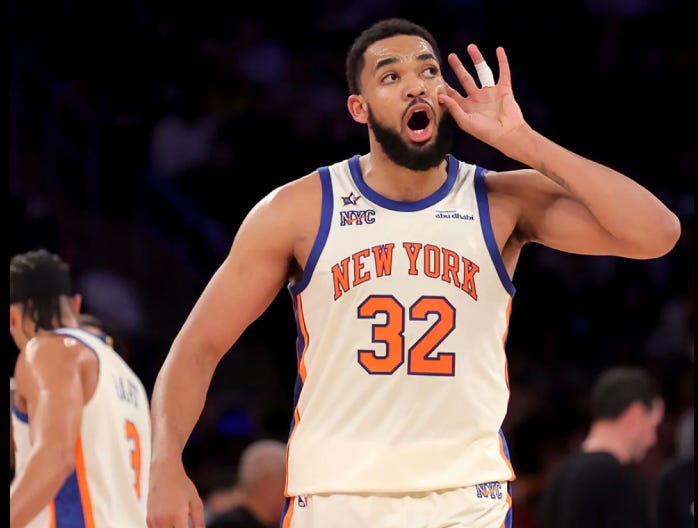
I said on Friday that there was enough discussion about KAT’s potential extension that I’d be writing about it this week. Well, sure enough, Ian Begley wrote yesterday that “if I had to take a guess,” Towns and the Knicks will find common ground on a new deal. He added:
If I’m using the recent Rudy Gobert extension as a baseline, I could see an extension for Towns starting around $45 million. By signing this kind of deal, Towns would obviously lose the opportunity to make more money as a 2027 free agent. But given all of the factors at play (the state of NBA economics, teams’ approach to the second apron, the Knicks’ title), there are reasons for Towns to play it safe and sign an extension.
This, obviously, is great news, but I’m still curious: has the marketplace shifted so dramatically that a player of KAT’s caliber would be amenable to a deal that is so far below his max?
To answer the question, I figured the best thing to do was take a look at the current state of max and near max players around the NBA.
By my count, there are currently 32 “true” max contract players in the NBA - a list that includes Karl-Anthony Towns. What is a “true” max player? For me, it’s anyone who received either a 25 percent max, a 30 percent max or a 35 percent max from their incumbent team for the maximum number of years (with the exact percentage based on years of service time) and/or is on a max extension signed off of their original max. Here’s the full list:
Donovan Mitchell, Shai Gilgeous-Alexander, Devin Booker, Jayson Tatum, Joel Embiid, Steph Curry, Giannis Antetokounmpo, Anthony Davis, Jaylen Brown, Jimmy Butler, De’Aaron Fox, Nikola Jokic, Karl-Anthony Towns, Cade Cunningham, Evan Mobley, Luka Doncic, Bam Adebayo, Jamal Murray, Anthony Edwards, Tyrese Haliburton, Paolo Banchero, Jalen Williams, Pascal Siakam, Franz Wagner, Scottie Barnes, Zach LaVine, LaMelo Ball, Tyrese Maxey, Des Bane, Darius Garland, Ja Morant and Michael Porter Jr.
There’s some variation within this group - player option vs no player option, as well as the number of years on certain extensions - but you get the gist. Notably, about a third are on what Windy refers to as the “fun max” of 25 percent. So really, if Towns looks around the league, he’ll only find about 20 other guys in his current weight class.
After this group, I have 10 additional players who are on what I’m calling a “fake max,” i.e., something that was probably reported as a max contract, but for one reason or another, it’s a “true” max. Some of these may be analogous to Towns, as I’ll get to in a bit. They are:
Zion Williamson - 5 years, $197.2 million. Zion signed a five-year rookie max, but with significant injury protections for the Pelicans.
Trae Young - 4/$212.8M (Player Option). Less than the maximum Young could have signed with Washington but equal to the max he could have signed for elsewhere. This deal, notably, was lampooned and questioned around the league as soon as it was reported.
Paul George - 4/$211.6M (PO). The max he could sign with a new team, but not the max he could have gotten from the Clippers before they let him walk.
Victor Wembanyama - 5/$252M (PO). Signed the 25 percent max. Deal did not include 30 percent supermax escalators that he was eligible for.
Chet Holmgren - 5/$239.2M. Like Wemby, this was a 25 percent max without the 30 percent supermax escalators he was eligible for, although it did included lesser escalators that could bring the deal up to 5 years and $250 million.
Lauri Markkanen - 4/$196M. Renegotiation and extension. Added $24.1 million to his original final year base salary, bringing him up to a 30 percent max in the final year of his old deal. His new deal also started at a 30 percent max, but went down in value in year-two before max raises set in for years three and four.
Jaren Jackson Jr - 4/$205M (PO). Another renegotiation and extension, adding $11.6 million to his original final year base salary. The resulting cap hit of the first year of the new contract was 29.7 percent of the cap, slightly below the 30 percent max he’d have been eligible for if he didn’t renegotiate and extend. The deal did not feature max raises, instead increasing by a flat $1.5 million each season.
Kawhi Leonard - 3/$149.5M. Started at a 35 percent max, but reduced slightly in value in years two and three.
Austin Reaves - 4/$184.8M (PO). Started at 25 percent max, with a four percent raise in year-two and close to max raises in years three and four.
Jalen Brunson - 4/$156.5M (PO). Extended for the maximum 40 percent increase over his previous year’s salary, which resulted in a first year salary of his extension that was 22.6 percent of the cap - significantly below the 30 percent he’d have been eligible to sign for if he hit free agency.
That’s it for group two. For whatever its worth, I think both Markkanen and JJJ are somewhat relevant comps, although I’m sure Towns sees himself as superior to both. Then again, KAT has also earned two max contracts in his career already. Both Lauri and Jaren signed deals that were well below the max following their rookie contracts, so each one was likely more incentivized for a big payday this time around.
Finally, we have the group that Karl-Anthony Towns may join: True sub-maxes. This group obviously includes countless players, but I’m listing five as potential comps in increasing order of relevance, followed by the contract I think we’re likely to see KAT sign:
