
Knicks Schedule Released
React accordingly. Plus, another Knick you almost knew from Ray Marcano.

Good morning! We can officially start booking tickets for the repeat tour…
News & Notes
The NBA has released the schedules for all 30 teams, and the Knicks got themselves a doozy:
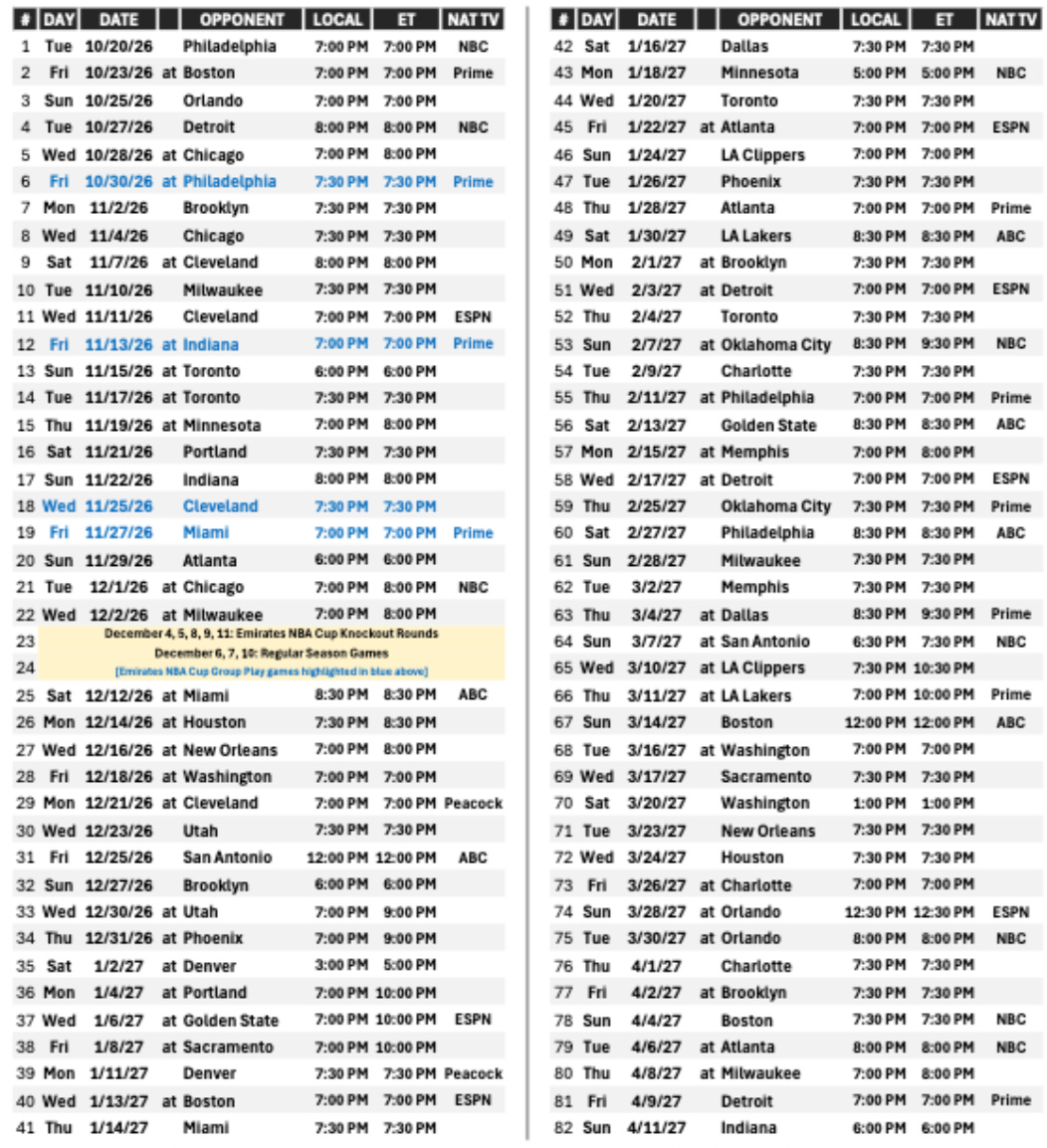
Let’s start with the good news.
The Knicks are part of 13 back-to-backs, which is tied with 11 other teams for the least in the league, and only two of those back-to-backs include a time zone change. They also have 17 instances of three games in four nights, which is fewer than all but two teams. In terms of total distance they’ll travel this season, only the Raptors cover fewer miles.
Last on the positive side, they play a very home heavy slate in the second half of the season. They get through with 21 of their 40 scheduled road games by Game 38, meaning they only have 19 scheduled road games in their final 44, and two of those are in Brooklyn. From Thursday, January 14 to Monday, February 1, they will only leave New York once, and it’s for a quick trip to Atlanta. They also have two other four-game home stands in the second half of the season, including coming out of the All-Star break. In other words, there will be ample opportunity to recharge their batteries before April.
They’ll need it. New York’s first half schedule is about as daunting as one can imagine. 11 of their first 18 games come against the Cavs (3 times), Sixers (2 times), Pacers (2 times), Raptors (2 times), Pistons and Celtics, arguably their six biggest competitors in the East assuming the Kawhi trade goes through. Six of those 11 are on the road and two of the home games are on the second night of a back to back.
Then, from December 1 to December 21, the Knicks currently does not have a home game scheduled. That may change depending on what happens in the NBA Cup group play games, but as of now, they won’t play at MSG for over three weeks. After a three-game home stand for the holidays that includes the Spurs on Christmas, they’re back on the road for a six-game western swing. Yeesh.
At the very least, they’ll get plenty of exposure with a league-high 34 national television appearances. Of their final 40 games, half will be available nationwide (depending of course on what services you get in your house, says Adam Silver from his Scrooge McDuck vault).
The biggest thing to remember, not just for the Knicks but for every team, is that tanking should significantly subside this season as bad teams try to stay out of the “relegation zone;” aka, the three worst records that will have their lotto odds sliced in half. The league also upped the odds for teams that make the play-in.
Taking that into consideration, I’d be bearish on many teams getting to high win totals, and it shouldn’t surprise anyone if the league only produces a handful of teams that win 50 games. That said, I expect the Knicks (who currently have the top East over under at 53.5 wins) to be one of those teams, and if I had to pick right now, I’d take a slight over.
I’d love to hear your predictions in the comments.
A Knick You (almost) Knew: Sherman White
by Ray Marcano


This next Knick You (almost) Knew was quite possibly the best player in college basketball and destined to play in Madison Square Garden before scandal ruined his NBA career.
Sherman White was born on December 16, 1928, in Philadelphia, PA. If there was anyone born to play basketball, it was White. He entered junior high school at 6-feet tall and was 6'5" by the time he was a sophomore at Dwight Morrow High School in Englewood, NJ, where his family moved when he was a child. Let’s put this in context. In the 1940s, the average 13 or 14-year-old stood less than 5 feet tall, and the average high school sophomore was 5'7".
So, it’s no surprise he dominated. His senior year in high school was most impressive. By then, he had grown another three inches, to 6'8", and was taller than most players on the pro and semi pro leagues of the time. He scored a then-record 49 points1 in a game, led his team to a 28-0 season and the Northeastern High School championship. He was also a unanimous first team all-state selection.
White signed with Villanova at the suggestion of his high school coach, and by all accounts, he hated the experience. He was the only Black athlete at a Catholic university, where he struggled academically and failed to fit in. He dropped out and enrolled at Long Island University.
It took him a while to show his skills, but by the time he was a sophomore, he grew into the team’s most important player. He was a second-team consensus All-American in the 1949 season. In 1950, he scored the most points in a single game in LIU history (63), a record that still stands.
He was a tall, fast player who could, as the cliché goes, leap out of a gym. The Knicks were thrilled because they owned White’s territorial rights, and as soon as his senior season was done, they would grab him. No doubt2.
But during his junior year, White became suspicious because his teammates weren’t performing as they should. Players started missing shots they would normally make. Eddie Gard, the point guard, threw passes at his feet, White told the New York Times. After one game that season, Gard and two other teammates --- Adolph Bigos and Dick Fuertado --- met with White and told him he could make some easy money by missing an inconspicuous shot here and there or helping rig games for gamblers.
White, who later said he bowed to peer pressure, agreed, and became a prominent figure in a point shaving scheme that is still the biggest scandal in college basketball history.
The scheme came to light in January 1951 when Manhattan College player Junius Kellogg refused to take a bribe to shave points and instead alerted his coach, who notified the New York District Attorney. From there it was as matter of time before the players were caught. The DA started arresting players, who began implicating others.
On February 19, 1951, White was named the Sporting News college basketball player of the year. The next day, he was arrested. As a co-conspirator, he made $5,500. He didn’t spend any of it and gave it to authorities when he was arrested.
“I knew it was a matter of time,” White later said. “I was in a fog. As far as I was concerned, my life was shot.”
Players from CCNY, Bradly, Toledo, and LIU, including White, along with an assortment of gangsters and bookies were arrested and jailed.
According to the book, The Scandals of ’51, White’s lawyer didn’t show up for his sentencing, and the judge lambasted him as “a hardened criminal and a semi-moron.” White received the longest sentence of 12 months at Riker’s Island (he served nine), a penalty that raised eyebrows because a number of the white co-conspirators received suspended sentences.
“I was a very defiant young man,” White told the Times, “and (Judge) Hogan didn’t like my attitude. I’ll never forget this as long as I live. He said, ‘You are going to jail.’ Right to my face: ‘You are going to jail. Your attitude is not the attitude of a college student. You act like you are an experienced criminal.’”
White was banned from playing in the NBA, and that was a tough blow for the Knicks. With White, New York could have rolled out a starting five of Nat “Sweetwater” Clifton, three all-stars in Harry Gallatin, Max Zaslofsky, and Dick McGuire, and White. Would that have been enough to beat the Lakers (Minneapolis, then) of George Mikan, Jim Pollard and Vern Mikkelsen, all-stars and either first or second team All-NBA?
White’s NBA dream was shattered like a cheap vase hitting concrete, but he did keep playing. Between 1953 and 1963, he played on the weekends in the Eastern Basketball League. He was the league’s most valuable player in 1955 and led the Baltimore Bullets to the 1961 league championship. He did that while selling cars and storm windows.
Over the years, White kept a low profile. He worked in sales to support his family and stayed involved with basketball, mentoring young men at the Newark and East Orange YMCAs. He declined to be interviewed for the 1998 HBO documentary on the scandal called “City Dump” fearing it wouldn’t tell the full story.
Still, he was lauded for his skill. In 1984, Madison Square Garden celebrated 50 years of hosting college basketball games. It named its all-college players and introduced White, one of the honorees, as “the virtuoso of New York basketball.”
In a Getty Images photo, White stood next to the giants of the game: Bob Davies of Seton Hall; George Mikan of DePaul; Tom Gola of LaSalle; Dick McGuire of St. Johns and Oscar Robertson of Cincinnati.
Bill Russell of San Francisco, Kareem Abdul-Jabbar of UCLA, Hank Luisetti of Stanford, Bill Bradley of Princeton, Maurice Stokes of St. Francis, Elgin Baylor of Seattle and Jerry West of West Virginia were also selected but couldn’t attend.
Talk about good company.
In 2007, The Draft Review called White, “the best player you never knew” In 2010, the basketball courts at Mackay Park in Englewood, NJ were named for White, honoring his work with young people.
White died on August 4, 2011 from congestive heart failure at his home in Piscataway, NJ. He was 81.
In 1999, Knicks great Dick McGuire told The Record of New Jersey, “Sherman would have put us over the top. We would have won championships with him. What you see now with Kevin Garnett, Marcus Camby and Lamar Odom, you saw Sherman doing back then. He was well before his time.”
Ray Marcano writes for some of the country’s biggest brands and has been named best columnist in Ohio two straight years (2025-26). You can read his free newsletter, the Bourbon Resource, right here on Substack.
🏀
“Injustice anywhere is a threat to justice everywhere.”
Former NBA player DaJuan Wagner now holds the New Jersey prep basketball single game scoring record. He scored 100 points for Camden High School in 2021.
From 1950 to 1965, the NBA had a territorial rights system in which teams could draft any player within a 50-mile radius of their arena in exchange for forfeiting its first-round round pick.
Wow. Great piece, Ray. I knew nothing about White. What a sad, sad story. If the same thing happened today, a decent lawyer would have been able to resurrect his NBA career.
As for the schedule, in the words of Ernie Banks, "Let's play 82." Can't wait.
I imagine the Clippers are an easier matchup than the Lakers for me to attend, but again the Kawhi trade looms large.