
Shamet's Back!
Landry Shamet will return to the Knicks on a 4-year, $24 million deal. Here's what it means and what big questions still remain.

Good morning! Woo Hoo! Landry’s back! We’ll talk about that in a moment, but before we get there, Vincent Goodwill reported late last night that the Knicks would not be extending a qualifying offer to Ariel Hukporti, making him an unrestricted free agent. The QO would have been worth $2.65 million, and would have gone on the books as such for New York. If, however, Hukporti signs a vet minimum deal, it will count as $2.45 million against the cap. Given that every dollar counts for the Knicks if they do intend to stay below the second apron, this could be one reason for the non-tender. Just as likely, the front office may not feel comfortable with the prospect of Huk signing his QO, thus taking away a roster spot in the process. As we’ll get into below, with Shamet back and the Knicks still looking to pinch pennies, every additional move requires that much additional scrutiny. At the very least, this move by the front office all but confirms that they have other ideas for the backup center position next season that don’t involve Hukporti stepping into a much more prominent role.
Shamet’s Back!
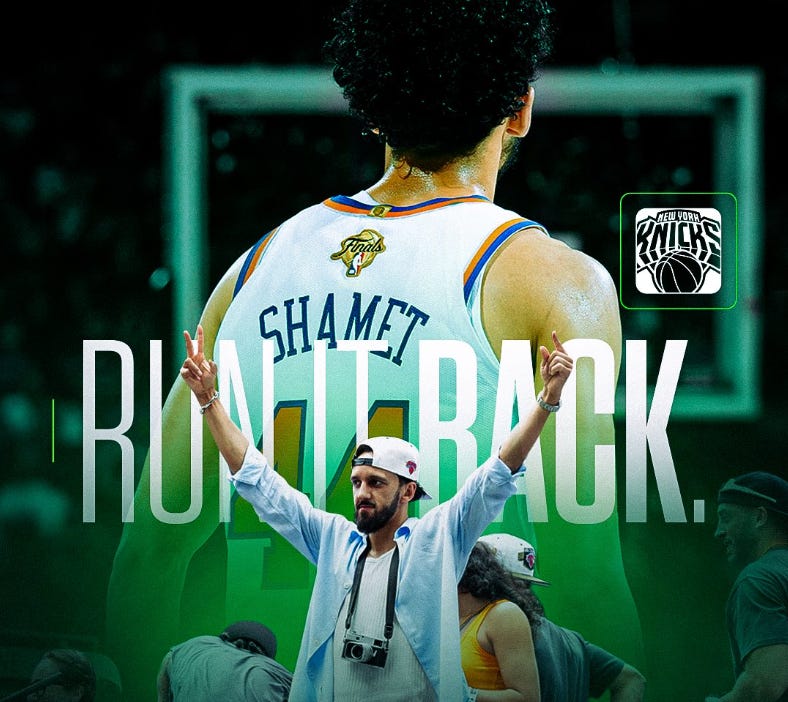
Early yesterday, before news hit that Landry Shamet would be returning to the Knicks on a four-year, $24 million deal, I was thinking about another under-appreciated bench wing who found his home in New York after a long and winding NBA career.
If you want to impress your Knick fan friends at a BBQ this summer, ask them to name the very first free agent signing of the Leon Rose era. My guess is most of them won’t land on Alec Burks, who Rose inked for one year and $6 million - the same annual value as Shamet’s new contract, funny enough - on November 22, 20201.
At the time, no one thought much of the deal. Burks was anything but a sexy name, having bounced around between five teams over the previous two seasons. Pop open the hood though, and this was a player who brought pedigree (a former lotto pick), size (6'5"), versatility (could play either wing spot while moonlighting as a combo guard), shooting (36.4 percent career mark from deep; 38.5 percent the prior year) and was arguably in the midst of his prime entering his age-29 season. Sure enough, Burks became a vital component of the #WeHere Knicks, capped off by 27 points on 13 shots in a thrilling Game 1 against the Hawks.
We didn’t realize it at the time, but getting Burks was a sign of things to come for a regime that has made their bones nailing signings around and between the margins. After Burks, we got Taj on multiple minimums, I-Hart for two years and $16 million, Donte on the midlevel, Deuce on his current bargain contract, Cam Payne on the minimum, Jordan Clarkson on the minimum, and of course, Landry Shamet on consecutive non-guaranteed contracts.
There is a downside to being so good at this part of the job though. After a player outperforms their initial deal, other teams with deeper pockets will come calling. As we saw with Alec Burks, that often puts the incumbent front office in a bind. Leon Rose re-signed Burks on a multi-year deal that needed to be dumped a year later, and in the process, learned a valuable lesson. No matter how vital a player (and especially a role player) feels in the moment, there’s always a price point that is irresponsible to exceed to bring them back.
Which brings us back to Landry Shamet. Much like with Burks, the front office identified Shamet as an asset who perhaps hadn’t found the ideal situation. A career 38.4 percent 3-point shooter when he initially signed with the Knicks, everyone knew Landry was a floor spacer who could operate off movement, and that he brought decent size, toughness, and some degree of positional versatility. At the same time, there were also questions about his defense and consistency which explained why he could be had on such a cheap deal.
To his credit, Shamet turned himself into a much more consistent defender over the last two years, getting to a place where he was arguably the best option guarding Donovan Mitchell in the 2026 Eastern Conference Finals. He also went from a player whose efficiency numbers felt like empty calories to one who could be counted on to take the biggest shots at the biggest moments of massive games. That he made this change while overcoming not one but two season-threatening shoulder injuries is a testament to everything he’s about, and thus, everything he means to this locker room.
For that reason, while it was easy to make an on-paper argument that Shamet would be easier to replace than Mitchell Robinson, the reality was more complicated. That decision was ultimately made very easy for Leon Rose, because as is so often the case in life and the NBA, answers can be found by following the money.
At an average annual value of $6 million per season, Shamet will make less than the taxpayer midlevel exception in each year of this deal. Put another way, he will count for less than three percent of the $222 million second apron threshold the Knicks are seemingly mandated to stay below. That’s incredible value for someone who was probably their sixth or seventh most important player during this postseason.
It’s also less than he could have gotten on the open market, as several reports indicated in the immediate aftermath of the signing. This, as much as anything, is the benefit of being reigning world champions in the greatest city in the world. If ever there was a situation where someone like Shamet, who had less than $33 million in career earnings before yesterday, would take a haircut to remain with his incumbent team, this was it. It probably doesn’t hurt that he has the full faith of head coach Mike Brown, who increasingly treated Shamet like a security blanket as the season went on. In re-signing with the Knicks, Shamet not only gets financial security, but the security of knowing he’ll continue to play a major role on a contending team as well.
In a perfect world, this signing would engender nothing but celebration, but alas, there is a flip side to this coin. Shamet being willing to re-sign on a discount is only half the story, with Mitchell Robinson’s presumably frothy market being the other half. Given the owner’s statements and all of the available reporting on the matter, Shamet’s contract may be the final nail in the coffin for Robinson’s Knick career (with one possible caveat we’ll get to shortly).
A part of me is curious about who the Knicks would have picked if, say, Mitch was willing to settle for something around $8-9 million next season, but that number feels considerably less than what he’ll wind up earning. I guess we’ll see. Either way, I’m not going to shovel any dirt on the Mitchell Robinson era until he officially signs elsewhere. If and when that happens, we’ll pay the appropriate respect at that time.
In the meantime, Shamet’s new deal does raise several obvious questions. Here are my top 6:
