
The Hard Way
A look at the unlikeliest championship roster that has ever been built, and the steps along the way to make it happen.

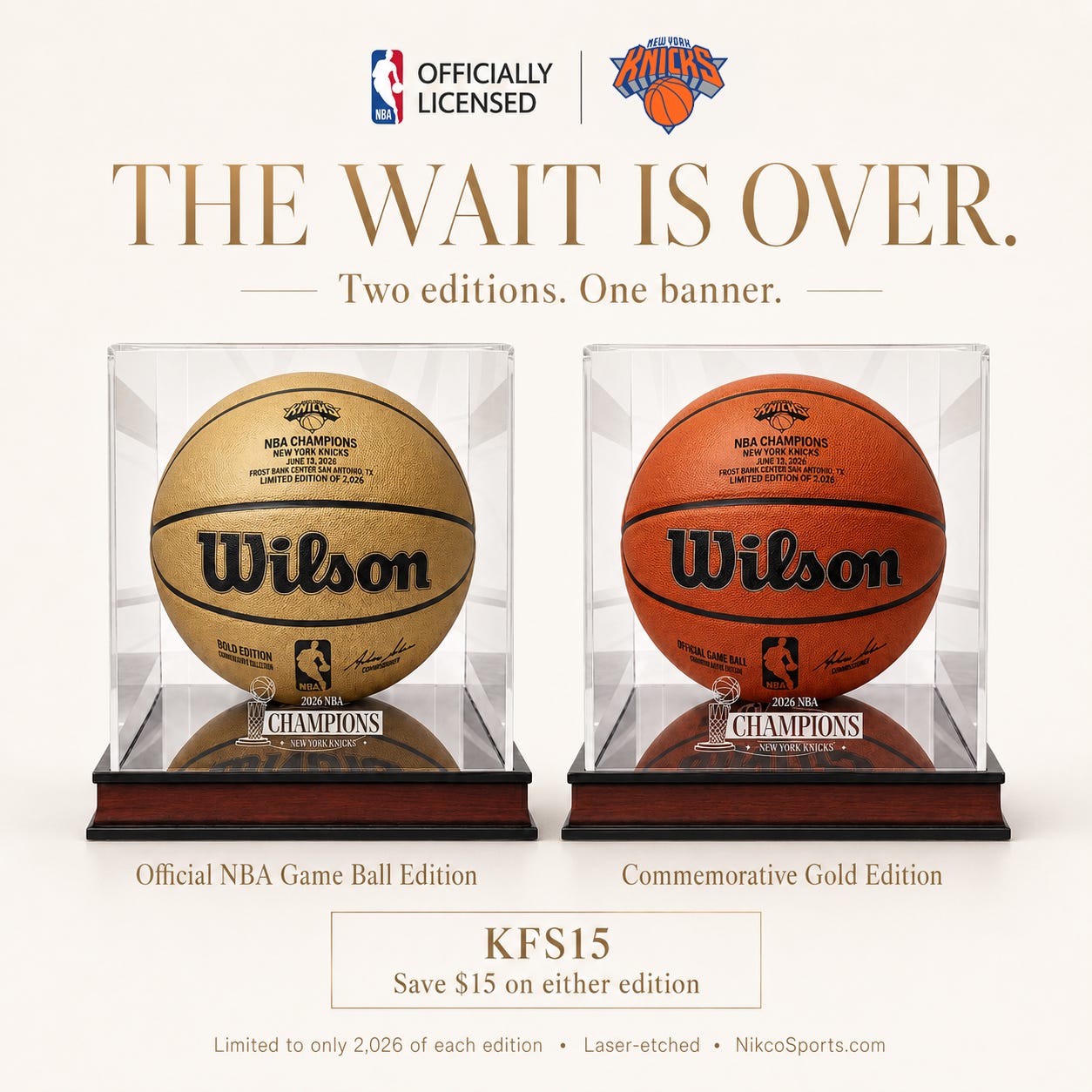
Good morning! Before we get to today’s newsletter, a quick announcement: I’ve partnered up with the fine folks at Nikco Sports to get a special deal to KFS subscribers on two officially licensed Knicks NBA Championship basketballs. There’s an official game ball and a gold edition, both of which are numbered to 2,026, and if you use the code KFS15, you’ll get $15 off your order. Go here to order, and check out the balls themselves in the snapshot at the bottom of this newsletter.
The Hard Way
Mike Tyson once said that everybody has a plan until they get punched in the mouth. Last season, Leon Rose took a hit. Maybe there’s more to his plan than meets the eye, but at the moment, it feels like there’s less. A lot less.
…
Four years.
It’s only been four years since I wrote those words.
Four years is nothing. It’s a presidential term. An Olympic cycle. The time between World Cups. High school.
Four years should not be enough time to take a franchise from NBA purgatory to the Canyon of Heroes, not without an insane amount of lottery luck (hi, San Antonio!) or an existing superstar reaching out and asking if you will accept this rose.
The Knicks? Their highest draft pick they actually rostered over those four years was Pacome Dadiet, taken 25th overall. Their biggest free agent signing was a zero-time All-Star who started 127 games in four years and inked a contract for roughly half of the max…and that deal was instantly, almost universally panned. They traded for a bunch of good players, but only one who had ever made an All-Star team, and he received zero MVP votes over the course of his career.
Not exactly a blueprint for success, let alone the ultimate success imaginable.
And yet here we are, a little more than a week removed from one of the dominant postseason runs in the history of the league, which itself capped a stretch of four years in which the New York Knicks have been arguably the steadiest, sturdiest, most competently run team in the NBA.
Was there more to Leon Rose’s plan than met the eye?
Yeah, I’m thinking there was.
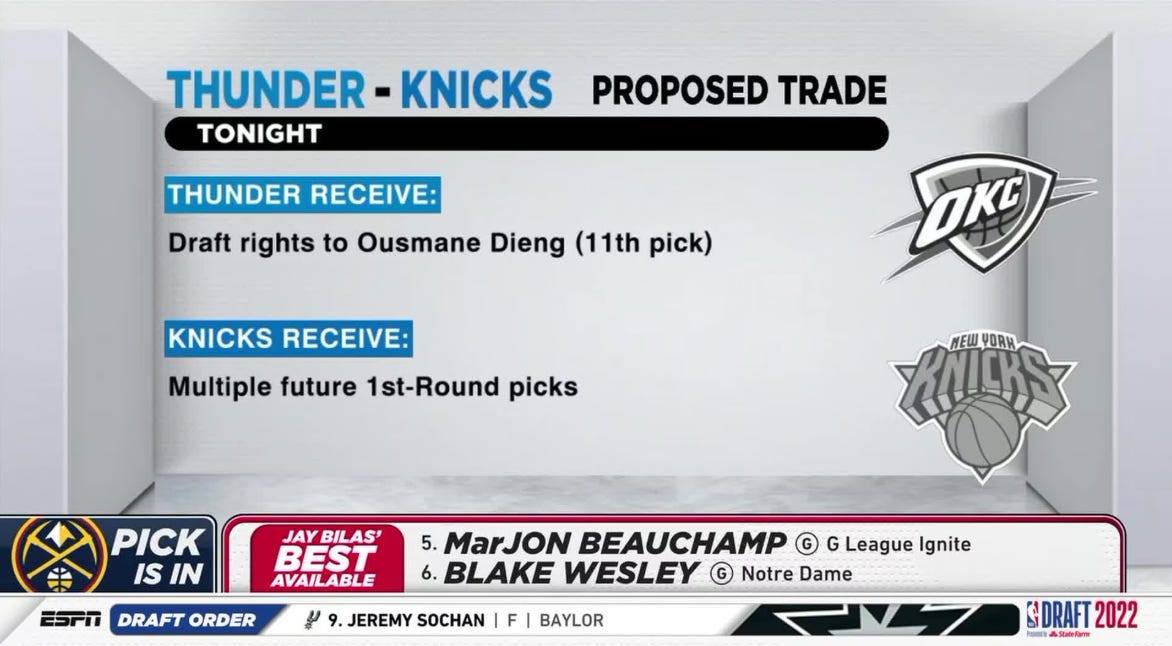
In my defense, I did write that the night of the 2022 NBA Draft would be Leon’s chance to prove my skepticism unfounded, and boy oh boy, did he ever. That much is no longer in doubt.
The only question is how he did it.
It is nothing short of staggering to go back and read some of the concerns I had following the 2021-22 season, which saw the Knicks finish 37-45 and fall from first round playoff host to out of the play-in entirely. Primary among those concerns was that the organization was putting all of their eggs in the “trade for a superstar” basket and forgetting about all of the other nuances of team-building along the way.
How ironic, considering that in the last four years, they’ve completed the most methodical, workmanlike championship roster-building gambit we’ve ever seen.
We didn’t have any inkling that such a future was in the offing though, not back then, when we were collectively fretting about (in no particular order) whether Leon would trade the 11th pick for Malcolm Brogdon, Alec Burks’ recovery from foot surgery, why they weren’t in play for Dejounte Murray, what the plan was for Cam Reddish, how they would navigate the Randle/Obi dynamic, whether they had enough juice to trade up for Jaden Ivey, and of course, would they actually be able to clear enough cap space to lure Leon’s godson from Dallas?
Wilder still is the list of items we concerned ourselves with over the first ~27 months of the Leon era. In texting with my good buddy Alan Sepinwall a few days ago, the name Luca Vildoza came up. You are forgiven if he doesn’t ring a bell considering his tenure with the Knicks consisted of two summer league games. Once upon a time though, his signing was seen as an under-the-radar coup - an “on the margins” signing that might pay big dividends down the road1.
Not so much. Nor were Jared Harper, culture king Theo Pinson, Michael Kidd-Gilchrist, Myles Powell, Skal Labissière, James Young (excuse me: former 17th overall pick James Young), Iggy Brazdeikis, da gawd Norvel Pelle, Rokas “surely the Lithuanian Goran Dragic” Jokubaitis, Dwayne Bacon, Luka Šamanić, Danuel House Jr, and of course, Killa Cam himself.
Those were all darts that New York flung at the bullseye before Jalen Brunson arrived. Other fan bases likely would have chuckled if they knew how much consideration we gave to some of these has been’s and never were’s, but we were just happy to have a front office that left no stone unturned as opposed to falling asleep staring at the clouds or quintupling down on any minor win. We knew it would only be a matter of time until this proactivity paid off.
Sure enough, it did, sometimes incrementally, and at other times immensely. For proof of that, look no further than the night they cleared the cap space necessary to sign the eventual 2026 NBA Finals MVP, and the series of moves that allowed that night to unfold as it did.
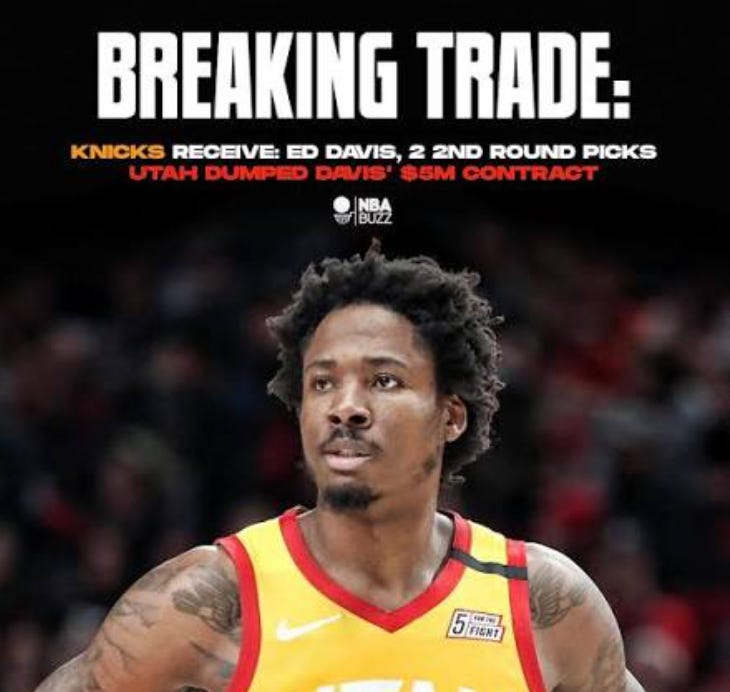
Way back in November of 2020, almost two years before Jalen Brunson stepped in for the injured Luka Donicic and out-dueled Donovan Mitchell for the first time (although certainly not the last), the Utah Jazz were already feeling the financial pain extending their young superstar.
Because of Mitchell’s impending max deal, they needed to make other moves to ensure their own financial viability as a small market team. To ease that burden, they decided to offload Ed Davis’ expiring contract to a team with cap space. Wouldn’t you know it, but the New York Knicks were all too happy to oblige, taking on Davis in exchange for two future second round picks.
We’ll get back to the second of those incoming picks in a moment, but the first (along with three other second rounders) was used two years later to acquire the draft rights of Jalen Duren from Charlotte, who the Knicks then flipped to Detroit along with their own unwanted money belonging to Kemba Walker. Tacked on to that deal was a future first coming back to the Knicks, which was then spun to Brooklyn in 2024 as part of the Mikal Bridges trade.
But those weren’t all the championship breadcrumbs laid down during Rose’s earliest months on the job.
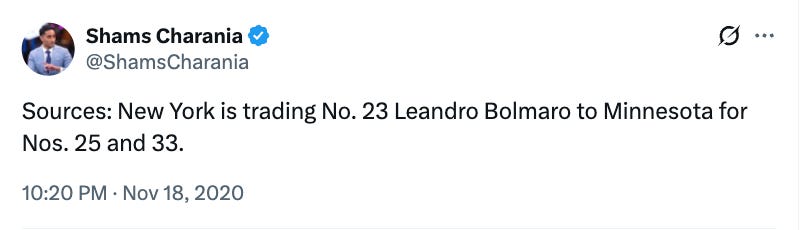
One night before that Ed Davis trade went down, New York selected Immanuel Quickley 25th overall out of Kentucky. Considering his time with the Knicks and his importance to the completion of the OG Anunoby trade, Quickley may go down as the most important draft pick of Leon’s tenure.
That selection didn’t come in a vacuum though. It was part a trade down that also netted the Knicks the 33rd pick, which they then sent to Minnesota for a future Pistons second rounder.
Fast forward back to draft night 2022, and they were able to send Detroit their pick back in exchange for taking on the expiring contracts of Alec Burks and Nerlens Noel. That pick eventually became James Nnaji, who as luck would have it. the Knicks re-acquired in the 2024 trade bringing them Karl-Anthony Towns.
So that’s two minor moves around the 2020 draft, which gave way to two major moves during the 2022 draft, which tied directly into two cornerstone acquisitions in the 2024 offseason, which brought the Knicks a world championship in 2026.
World domination incoming in the summer of 2028? It can’t be ruled out.
Looking back, it’s actually hard to find a major transaction that wasn’t at least partially enabled by an earlier, smaller move. In the OG trade, the pick New York sent to Toronto along with IQ and RJ was acquired when they slid down from 21 to 25 in the 2021 draft. The player they bypassed, Keon Johnson, has been out of the NBA for a year. The player they took, Quentin Grimes, was the key component of the trade sending Evan Fournier to Detroit for Bojan Bogdanovic and our old friend Mr. Burks. Bogey was then the outgoing salary sent to Brooklyn for - you guessed it - Mikal Bridges. Even the semi-disastrous Cam Reddish trade became semi-useful when he went to Portland in exchange for Josh Hart.
The Reddish trade is also a good reminder that not every decision made by the Rose regime was a good one. Those 2022 draft night trades amounted to a nice bit of business, but they also rendered a final verdict on the bevy of poor 2021 signings. Ditto for Guerschon Yabusele (oof) and Even Fournier, who more or less gave the Knicks what they should have expected, but was still a significant whiff. Draft-wise, New York took other players exactly one spot ahead of Jalen Johnson2, Herb Jones3, Jalen Williams4 and Moussa Diabaté5, did draft Ajay Mitchell and immediately traded him for not very much, and in perhaps Rose’s biggest swing and miss of all, chose Obi Toppin ahead of Tyrese Haliburton. They’ve also gotten unlucky, losing a vital starter in Isaiah Hartenstein to a team with a boatload of “use it or lose it” cap space and a hankering need for toughness and rebounding.
The prior paragraph might seem like a slight, when in fact it’s the biggest reason Leon Rose has been wildly under-appreciated around the league, for two reasons:
Everyone screws up. Ousmane Dieng, the guy OKC gave up all those picks for on draft night in 2022? He was dumped at the trade deadline after three and a half wildly uninspiring seasons. The almighty Spurs gifted the Raptors the 2019 title with the most absurd superstar trade of our lifetime. And then just this season, the darling Boston Celtics traded a key bench piece in Anfernee Simons for a backup center who became unplayable in the playoffs. No team is infallible, but as Mike Tyson once said…
Everyone has a plan until they get hit in the mouth. The key is how you respond, and despite my fears heading into draft night four years ago, no front office in the league has responded to adversity better than the New York Knicks.
Lost Isaiah Hartenstein and can’t figure out what to do with Julius Randle? Trade for Karl-Anthony Towns.
RJ Barrett fits like a square peg in a round hole, and Immanuel Quickly wants double what you’re willing to pay him to be the best backup guard in the NBA? Make a deal for OG Anunoby.
Didn’t get Donovan Mitchell? Hand the reigns of the team over to Jalen Brunson.
The superstar trade you were waiting for never materialized? Swap those picks for someone you know is going to fit with your core and help everyone else be the best versions of themselves.
And perhaps most impressively of all, the head coach your team sculpted its identity from just couldn’t get you over the hump? Hire someone who retains all the good stuff from Thibs but with all the unpleasant gaps filled in.
They’ve always known when to hold, starting with Julius way back in 2020. They’ve also known when to strike, and viewed other teams undervaluing their players as an opportunity, not a red flag. To varying degrees, the Minnesota Timberwolves, Toronto Raptors, Portland Trailblazers, Brooklyn Nets and Dallas Mavericks were all hesitant to commit to five players who comprise the current championship core. I wonder how those teams are feeling today?
And then there’s the flat out home runs. Quickley at 25. Deuce at 36, followed by one of the savviest extensions in the NBA. Diawara at 51. Hell, Huk at 58. Donte for the midlevel. Hartenstein on a deal that ended up being too good. Shamet on not one but two vet minimums. Alvarado for peanuts. Josh Hart - Josh freaking Hart - for a late first and a guy who hasn’t played NBA basketball in 15 months.
Oh, and the guy Bill Simmons just ranked as a top-50 all-time player for four years and $104 million.
About that guy….
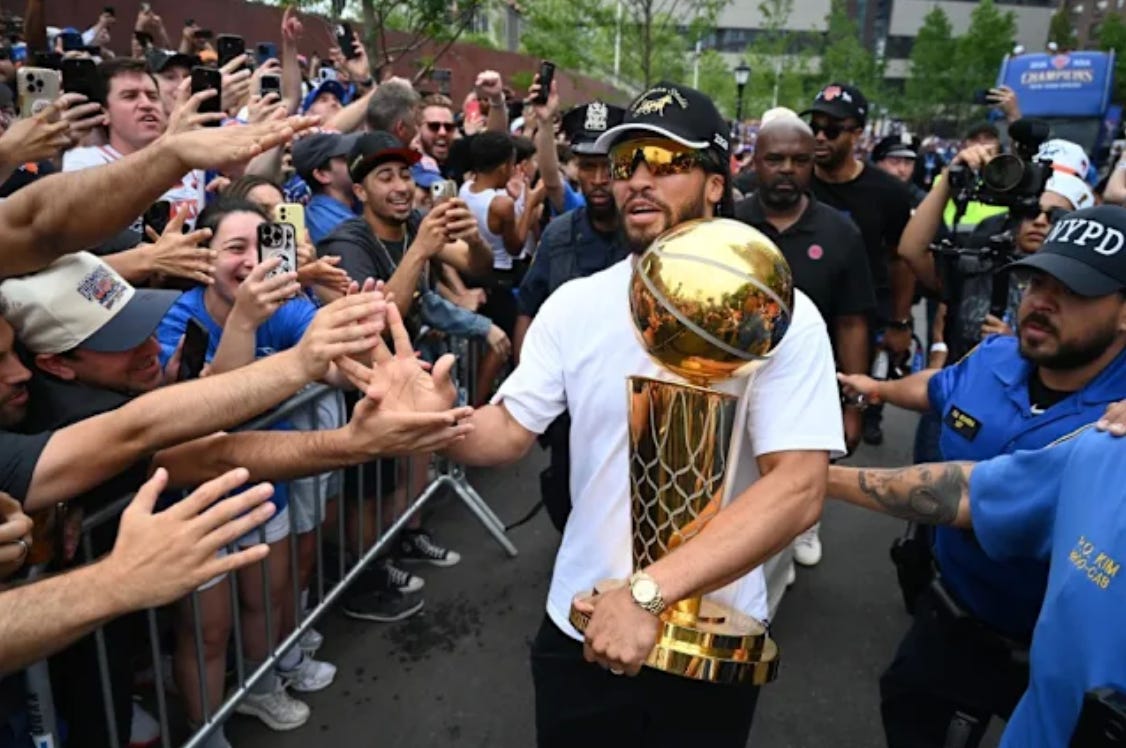
It’s tempting to say that Leon stepped in shit when the son of his first client just so happened to blossom into one of the greatest players in the game. To some extent, he did.
But to simplify this title to that extent diminishes the crux of this grand experiment.
The Brunson signing was nothing like, say, Kevin Durant going to Golden State or LeBron James going to [insert team here]. Zero creativity was needed to make the KD/Curry partnership work because Steph is Steph, and a college student with a half decent knowledge of the league can figure out LeBron + shooting = success.
Brunson was different. As Becky Hammon knows all too well, a championship team had never before been built around a small, defensively challenged guard. Leon Rose deserves credit for believing it could be done, but that was the easy part, especially considering their shared history. He really deserves credit for going out and building the damn thing, and doing so almost from scratch.
Go back to the moment Brunson was signed. There was no top-five player on the roster. Or a top-10 player. Or a top-25 player. Or a top-50 one. According to ESPN, RJ Barrett was the highest ranked Knick, checking in at 63. Brunson came in at 67, Randle at 71, and Mitch at 98. Elsewhere around the league, KAT clocked in at 13, Mikal at 49, and OG Anunoby at 75 (one spot ahead of 2026 Walker's Cay Open champion fisherman, Ben Simmons).
Those rankings are made to be derided, but that doesn’t change the perception of these players not long ago.
It isn’t just that a team centered around someone of Brunson’s stature had never won. Virtually every previous champion had a second traditional shot creator. Virtually every previous champion rostered at least one player who had made 1st Team All-NBA. Virtually every previous champion drafted at least one of their stars. Virtually every previous champion wasn’t coached by someone fired multiple times. And no previous champion gave up that many picks for a guy with zero All-Star appearances.
In this very specific sense, Leon Rose is the perfect embodiment of the team he built, and vice versa. Just like it’s no use telling the Knicks the odds when they’re down by 20 or more points in the second half of a game, there was no use telling Leon Rose the odds of building an NBA champion in the manner he did.
Brick, by brick, by blue and orange brick.
309 individual transactions in all6. 309 steps toward City Hall and Alicia Keys and basketball immortality.
Was it easy? Hell no. And why would it be?
This is New York.
We don’t follow roads. We make new ones.
And from now until the end of time, the 2026 New York Knicks will stand as a bright shining example of what is possible with a little faith and a lot of hard work.
So here’s to Leon Rose’s grand plan.
You did it, my man. You really, actually did it.
And no one can take it away from you.
🏀
“Injustice anywhere is a threat to justice everywhere.”
A quick Google search reveals that his name appeared in this newsletter no less than eight times, although this frankly seems low.
Taken one spot after the pick that they traded to Charlotte for the pick that they later traded for Cam Reddish
Taken one spot behind Rokas Jokubaitis
Taken one spot after the pick they traded to OKC for three first round picks, one of which was flipped to Detroit in the Duren trade, one of which was sent to Minnesota in the KAT trade, and one of which conveyed as two seconds from Washington, the first of which comes at 31 Wednesday night. Yes, I know, a big part of this trade was about clearing the obligation of a first round pick salary, which would have further muddied the waters in an effort to sign both Brunson and Hartenstein. That’s not the point. I’m simply acknowledging the fact that they had the opportunity to take Williams, and had they known he’d turn into this level of player, they surely would have found an alternative way to dump salary, like attaching a draft asset to get off Derrick Rose’s expirign $14.5 million contract.
Taken one spot after Trevor Keels; ouch.
According to the official transaction log on Basketball Reference
Let’s not forget that Leon put together a first rate management team. I am not sure what World Wide Wes has contributed but we know about Brock Aller’s wizardry. And a lot of the team DNA was inherited from Thibs, including the game’s never over ethos. Including making comebacks in the playoffs from 20 point deficits three times last year (and another 7 times in the regular season) on the positive side and playing their starters with 20 point leads and a few minutes left in the game on the negative side.
It has continued to surprise me that Leon Rose has received just about zero votes for executive of the year since he has been in place as the Knicks President (and essentially GM). As the Knicks were growing and winning, you would have thought that he would have come in at least 2nd or 3rd or even 4th, let alone win the award.
Now comes possibly the harder part. Building a championship team is wildly difficult without lottery success (still pisses me off the San Antonio has won three lotteries when hall of fame centers were coming out) but maintaining the championship culture is just as hard, if not harder.
Tuesday and Wednesday will be fascinating and incredibly important. Besides finding a way to keep Mitch, Jose, Mo and Shamet, the Knicks have three picks. A first, an extremely valuable second (first in round two/ first pick to lead off Wednesday) and a low level 2nd round pick. These all represent cheap roaster fillers, potential rotation guys and/or future picks if Leon plays his hand right.