
The KAT-rospective
Special guest author Thilo Latrell Widder begins a 4-part series looking back at Karl-Anthony Towns' postseason progression over the course of his career.

Good morning!
First things first: the Thunder did the Knicks no favors last night, losing in Boston to the hot-shooting Celtics. With OKC on the final game a five-game east coast swing, perhaps we should have seen it coming. Either way, Boston is back up by a half a game.
Next up: the Knicks play basketball tonight in the first game of what I would define as the “home stretch” (if this were a dinner, the Pelicans game was the amuse-bouche). Seven of the remaining nine games come against teams still playing for something, and the two teams that aren’t - Chicago and Memphis - both have wins against Western conference playoff teams in the last week. Tonight’s matchup against the Hornets will pit the team with the best net rating in the league since January 1 against the team with the best net rating in the league since January 20 (Charlotte is up to 6th overall in net rating, one spot behind the Knicks). This will not be easy.
Standing front and center in this matchup, as he has been for most games over the last six weeks, is Karl-Anthony Towns. Like many teams, the Hornets don’t have an ideal defender in their starting five to match up with KAT, and he should be able to do some damage. In truth, when he’s playing like he has been lately, there isn’t a player in the league who should be able to slow him down.
Players who can reach that rarified air of “matchup proof” are the ones teams generally climb over themselves to attain because they often lead to trophies, yet the Timberwolves never won a playoff series with Towns as their best player. They ultimately moved on from him, mostly for financial reasons, but in doing so they banked on their own ability to survive that loss. Sure enough, they made it as far last season as they did the prior year with KAT still on the roster.
We’re not about to rehash that trade for the umpteenth time (although if we did, the Knicks have taken the lead and are gaining separation, despite what some have prematurely argued). Instead, I thought it would be more valuable to get a first-hand accounting of the playoff journey Karl-Anthony Towns has taken to get to this point. I don’t know about you, but I feel fairly confident that for the Knicks to win it all, KAT will need to have the best postseason of his career. My hope is that in examining his playoff path up until now, we can see that exact outcome come into focus.
Without further ado…
KAT-rospective, Part I: Early Failures
by Thilo Latrell Widder
You know how NFL fans have talked about how a modern Peyton Manning couldn’t exist today? I understand this is a basketball Substack, but please bear with me for a moment.
So much of the historical conversation about Peyton Manning is about his greatness, the Superbowls, the forehead. But the truth remains that even considering how good he became, the breakneck pace of development in the current NFL would never allow for a QB who threw 43 interceptions in his first two years (or 81 in his first four, if you’d prefer that) to get continuous opportunities until he finally became the legend of the game he’s known as today.
We in the NBA world are lucky enough that this is not the case. Darius Garland, for example, was statistically one of the worst players in the league in his first year1. Awful rookies frequently become real difference makers down the line. Even apparent busts like Dante Exum can become usable bench players a decade after they are drafted.
To that end, if it were not for this standard, you could have watched 2018 Karl-Anthony Towns in the playoffs and found yourself convinced that he would never, ever be a part of a team that was winning anything. And you would have been deeply wrong.
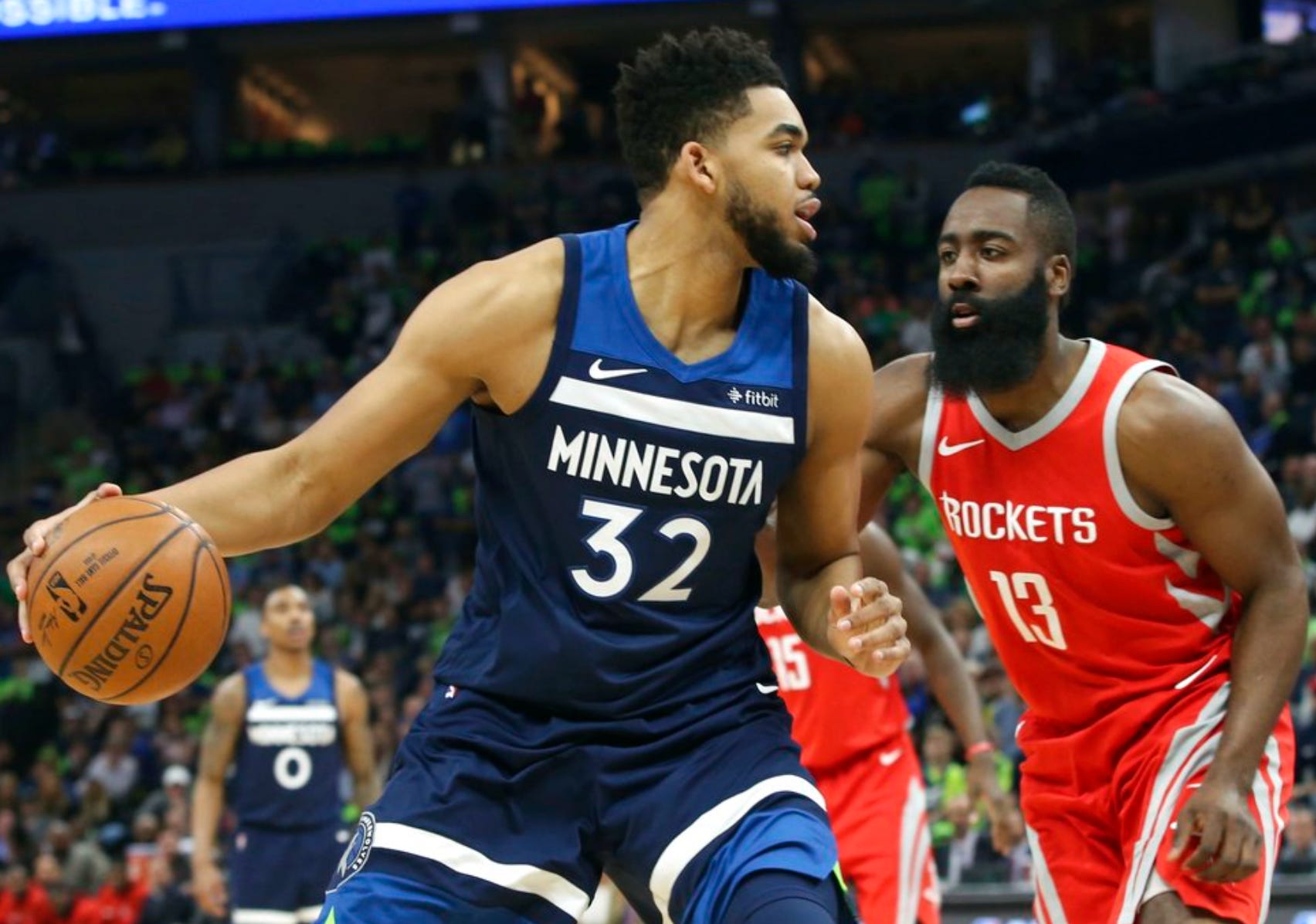
Welcome to the KAT-rospective.
I am your host, Thilo Latrell Widder. I am a Timberwolves reporter for Canis Hoopus that has also been doing some graphic design work for KFS. In that way, I guess I’ve kind of followed KAT here as well, even if I was a New York City resident before him.
The fastest way to understand the present of someone is to understand their past, so through this series, we’ll be looking at Karl’s playoff runs before he was a Knick in the hope that we can figure out who he was, who he is, how he got here, and most importantly, who he can be in preparation for the Playoffs this season.
On that note, let’s get started with the playoff series that made me question if basketball was worth caring about: 2018’s top seeded Houston Rockets against the eighth seeded Minnesota Timberwolves.
Before we get to anything on the court, I think it’s important to start with the elephant in the room. I am, and likely always will be, a KAT defender. I will not go so far as to stretch the truth and exculpate him completely (especially in this first series), but the blame of the 2018 burnout should not be placed entirely on him, despite the dreadful stats.
To that point, let’s start with who I think deserves the most blame.
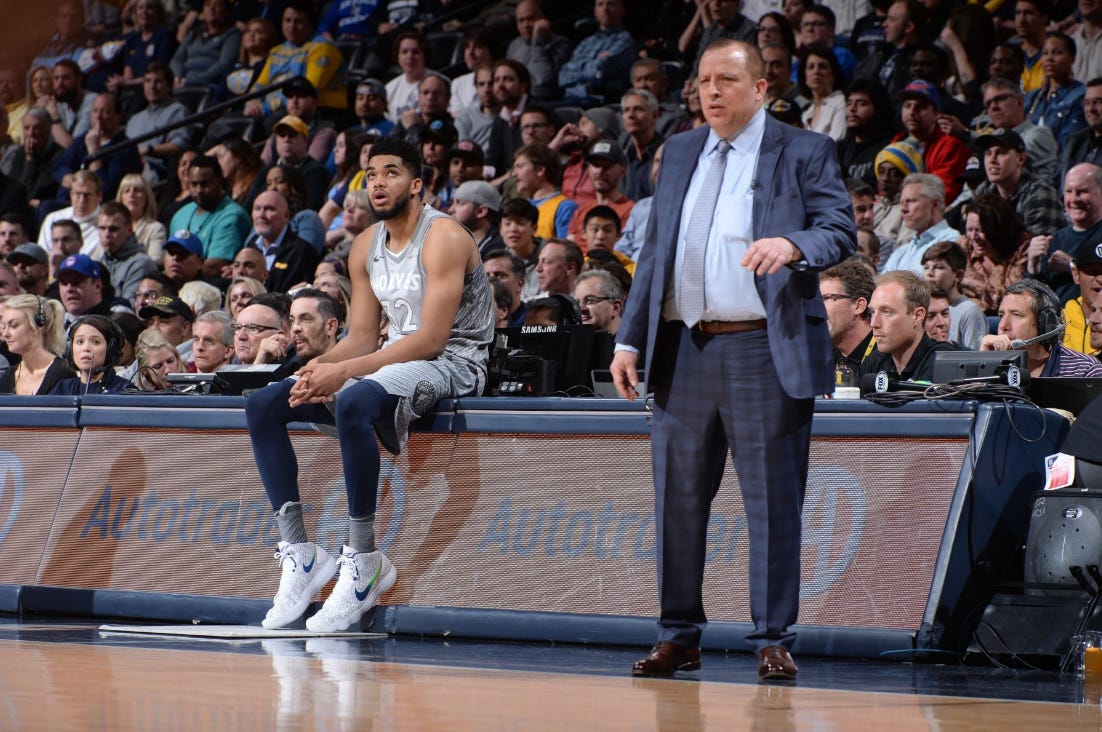
I’m sure there are many of you in Knicks circles (cough Jonathan Macri cough ) that remember Thibs as he was in New York, and to some extent in Chicago. I want to offer you all a disclaimer and a written bit of yellow caution tape:
I have never seen a coach put his star in a worse position to succeed than what Thomas Joseph Thibodeau did to Karl in that series.
Thibs was simultaneously trying to put KAT in all-offense lineups that didn’t leverage any of his strengths while also blowing a gasket at defensive failures that were almost entirely built into the scheme, not just the player.
Let’s start with the lineup choices. There were real moments in this series – we’re talking important third quarter stretches – where Towns was stuck out there with Tyus Jones, Jeff Teague, Derrick Rose, and Nemanja Bjelica.
Usually, three guard lineups are deployed with some level of intentionality. Remember when Steph Curry would share the court with Jordan Poole and Gary Payton II? All of those players have been categorized nominally as point guards, but Steve Kerr used Payton as the screener and ran both Poole and Curry off and on the ball to create good shots in a high movement offense.
By contrast, the trio of Jones, Teague, and Rose all had the same flaws with overlapping and marginal benefits. Please don’t get me started on the amount of times Jamal Crawford was thrown into that mix, leaving KAT as a glorified Ryan Anderson.
The defense was no better. The fact that Towns was continually asked to play in drop is baffling. That’s why so much of the conversation on Towns’ defense always felt disingenuous. You’re asked to play in a system that doesn’t suit you, in lineups that put you in the spotlight in all the wrong ways, on a team actively fracturing…and people were disappointed with the results2?
All that blame on Thibs does not, however, mean we can’t be realistic about how poorly Towns played and how clearly the issues that still plague him popped up way back then. Schemes can change, as they did. Shots can start falling, as they did. But what truly made this series such a nightmare was how KAT reacted when everything was going wrong.
There’s a moment within the first couple of minutes of Game 1 where KAT battles for post position with Clint Capela. He gets pushed out to the three point arc, drives, launches some BS off the box of the backboard, and then doesn’t get back in time to stop a fast break leading to a Trevor Ariza layup.
This was one of nine shots he would take in the game. A couple minutes later, a bad entry pass from Jeff Teague led to a turnover in a similar situation.
Despite shooting just 3-for-9, his overall impact in Game 1 wasn’t even that bad. He only scored eight points, but he didn’t single-handedly submarine the team. Losing by three in your first matchup against a team that was historically significant is not the end of the world.
But it was at this moment that the series clearly began to fall apart for Towns. If you’re supposed to be a one way superstar, you need to make those defensive issues worth it. Instead, KAT would double and triple down on an approach that simply wasn’t working.
In Minnesota circles, we call the concept “stray voltage.” You know those behind the head passes or galloping drives that inevitably end with a charge? Yup, that’s stray voltage. This series was a power outage. It was an electrical storm that would shut down city blocks.
That started in earnest in Game 2.
He just wanted to do too much. He wanted to be involved enough to say that, no, the last game wasn’t all he could do.
Early in the first quarter, there’s a stretch where KAT fouls Ariza in the air on a rotation to the rim where he was simply overeager to have a highlight moment. When Ariza misses the second free throw, Karl fails to grab the rebound as it bounces straight to him.
More time passes. KAT gets his first offensive opportunity of the game in the classic trailer three situation. He nails it. That happens with seven minutes remaining in the first. From there, he immediately hits a hookshot after battling for position against Capella. His next shot comes when he clanks a three, his first touch after a brief bench stint, with 11 minutes left in the second. The long rebound leads to an open pull up three from Gerald Green.
After three empty touches lead to nothing, KAT dons his homemade cape again and takes a turnaround jumper from the baseline with the shot clock running down. He misses. A minute later, his next shot is a rushed three from the right corner. Brick. He misses seven straight shots. He does not attempt another shot for 30 minutes of gametime (the last six minutes of the second quarter and the 24 minutes of the entire second half).
There was so little balance in this version of Towns. He either wanted every bit of offensive workload or none of it.
Across the first two games of the series, KAT scored 13 points. He would score over 15 in each of the last three games, but it wouldn’t matter. The counting stats looked decent by the end of the series (15 points and 12 rebounds) but they felt like empty calories.
There was a bit of Andre Drummond to it all. The numbers meant little. The impact was surely negative. The Wolves lost their first playoff series in 15 years in five games. They put up a good fight in less than half of them. Even if the defensive issues weren’t helped by the scheme, the feast or famine approach to offense buried Minnesota’s chances early.
It reminded me of something that Greg Anthony used to say as a commentator in 2K18 when a player would hoist up a heavily contested shot: that young man needs to let the game come to him. That seemed to be the missing piece with KAT early on…the ability to pull his teammates together without losing credibility, to push his own possessions without all of the silly stuff, to be an offensive superstar without trying so hard to convince everyone – including himself – that he was one.
A lot of KAT’s image gets attacked because he’s a goofy, fun loving guy who talks weirdly sometimes. There’s no question that toxic ideas of masculinity play a part in it. But back in 2018, he clearly had a self image problem, just as the larger NBA had a flawed idea of what he should be.
Those two ideas of who he should be were clearly fighting within him. That was the story of the early half of his career. No one knew who KAT was supposed to be, not even himself.
As everyone knows, the 2018 team was deeply dysfunctional. It imploded in the regular season when a Jimmy Butler calf injury caused them to fall from the third seed to fighting for a playoff spot on the last night of the regular season. It imploded again in the offseason when Jimmy Butler… well… did what he tends to do.
The Wolves wouldn’t make it back to the playoffs for the next few years, instead struggling with mediocrity and wasted picks before trading everyone on their roster at the 2019 deadline to bring in seven new players. It left KAT as the only member of the ‘17-18 team still standing just two years later.
That fire sale and the COVID pandemic would lead to the 2020 Draft and the arrival of Anthony Edwards, plus swingman Jaden McDaniels and head coach Chris Finch.
We’ll get to that next time when we examine Minnesota’s 2022 series against the Memphis Grizzlies, when Karl-Anthony Towns went from overwhelmed to overtasked.
🏀
“Injustice anywhere is a threat to justice everywhere.”
I don’t need to remind anyone reading this that Deuce McBride was one of the very worst shooters in basketball over his first two seasons as a Knick - Macri
I’ll note here that in New York at least, we’ve occasionally wondered whether KAT’s forays into drop coverage have always been directed from the sidelines or whether they were a result of him going rogue. The Athletic article following their playoff elimination last season gives some credence to this theory - Macri
Thanks for this review of the man we love to love (and some love to hate). The relevant part of that clip is that KAT complains, albeit briefly, to the ref that he was fouled. (He was.) His complaints have only grown louder and more frustrating with age. And he still gets about one call for every three he deserves.
I've become a KAT Truther myself so this is a good look back on the guy.